Implementation Intentions: The Specific Planning Strategy That Turns Goals Into Follow-Through
Implementation intentions — 'if-then' plans backed by 94 studies and 30 years of research — are one of the most effective strategies for closing the gap between what you intend to do and what you actually do. Here's the science and how to apply it.
You set the goal. You meant it. You even wrote it down. And then — nothing happened.
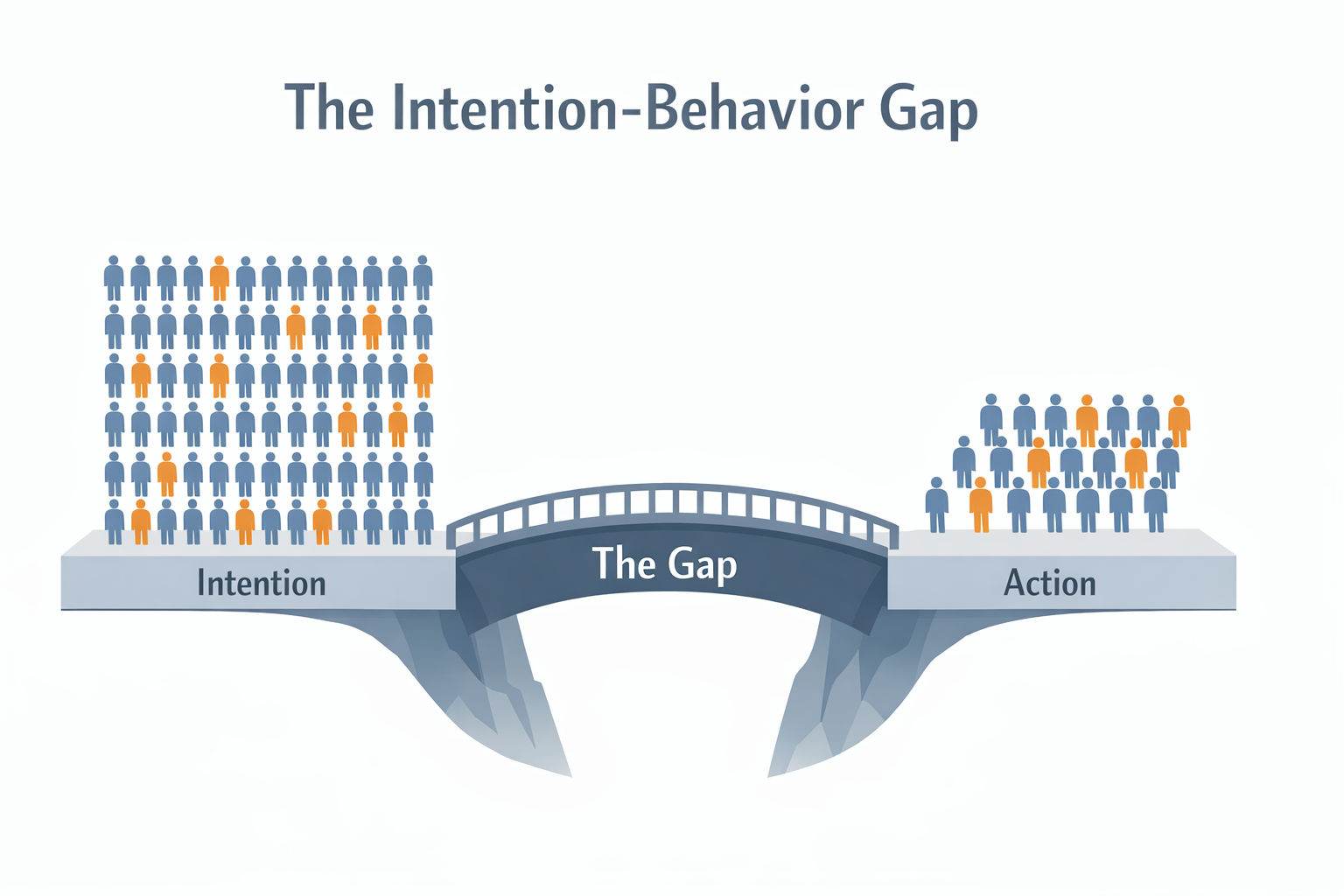
If that pattern sounds familiar, you’re not experiencing a willpower deficit. You’re experiencing the intention-behavior gap, one of the most well-documented phenomena in behavioral science. Psychologist Paschal Sheeran’s meta-analysis of 422 studies found that roughly 54% of people who form a genuine intention to act fail to follow through (Sheeran, 2002). Half of your goals are dead on arrival — not because you don’t care, but because caring isn’t enough.
The good news: there’s a specific, research-backed planning strategy that closes this gap. It’s called an implementation intention, and it has been replicated across 94 independent studies with over 8,000 participants. It’s one of the most robust findings in goal psychology. And almost nobody outside academia talks about it.
What Implementation Intentions Actually Are
The concept was introduced by psychologist Peter Gollwitzer in a foundational 1999 paper in American Psychologist titled “Implementation Intentions: Strong Effects of Simple Plans.” Gollwitzer drew a sharp distinction between two types of intentions:
Goal intention: “I intend to achieve X.” (e.g., “I want to write more.”)
Implementation intention: “If situation Y arises, then I will perform behavior Z.” (e.g., “If it’s 9am and I’ve opened my laptop, then I will write for 45 minutes before checking email.”)
The difference is structural, not motivational. A goal intention states what you want. An implementation intention specifies when, where, and how you’ll act — linking a concrete situational cue to a specific behavior. Gollwitzer described this as delegating action control to the environment rather than relying on ongoing conscious deliberation.
People do not have to deliberate anymore about when and how they should act when they have formed an implementation intention — unlike people who have formed mere goal intentions.
This isn’t a semantic trick. The if-then format triggers a fundamentally different cognitive process — one that has been measured across three decades of experiments.
The Evidence: What 94 Studies Show
In 2006, Gollwitzer and Paschal Sheeran published a meta-analysis covering 94 independent studies and more than 8,000 participants across health, academic, professional, and interpersonal domains. The headline finding: implementation intentions produced a medium-to-large effect on goal attainment (d = 0.65), with participants who formed if-then plans succeeding two to three times more often than those who relied on goal intentions alone.
To put that effect size in context: d = 0.65 is larger than the average effect of most behavioral interventions studied in psychology. It’s not a marginal improvement. It’s a structural one.
One of Gollwitzer’s classic demonstrations makes the effect tangible. Students were asked to write a report over Christmas vacation — the kind of task that’s easy to postpone indefinitely. Those who formed a goal intention alone (“I intend to write the report”) completed it at a rate of about 33%. Those who also formed an implementation intention — specifying exactly when and where they’d start — completed it at a rate of roughly 75%. Same goal. Same motivation. More than double the follow-through.
The intention-behavior gap: about 54% of people who genuinely intend to act never follow through (Sheeran, 2002).
The mechanism isn’t motivation. People in these studies weren’t more committed to their goals — they processed their goals differently.
Gollwitzer’s research identified three cognitive effects that explain why implementation intentions are so effective:
1. Heightened cue accessibility. When you specify a situational cue in the “if” component, your brain encodes that cue as highly salient. In attention studies, participants with implementation intentions detected their specified cues faster and more reliably — even when those cues appeared in a non-attended channel in dichotic listening tasks (Wieber, Thürmer & Gollwitzer, 2015). You literally become more likely to notice the moment to act.
2. Automatic action initiation. The if-then format creates a strong associative link between the cue and the response. When the cue appears, the behavior is initiated quickly, efficiently, and often without conscious deliberation. Gollwitzer calls this “strategic automaticity” — you’re deliberately installing a quasi-automatic response. Neuroimaging research confirms that implementation intentions recruit brain areas associated with bottom-up, stimulus-controlled action rather than the effortful top-down processing that goal intentions require (Bieleke, Keller & Gollwitzer, 2021).
3. Performance under cognitive load. Because implementation intentions shift control to stimulus-driven processing, they protect performance even when self-regulatory resources are depleted. Studies show that participants with if-then plans maintained effective performance under dual-task conditions and high stress — conditions where mere goal intentions consistently failed (Gollwitzer, 2014).
The key insight
Implementation intentions don't increase your motivation. They reduce the cognitive cost of acting on motivation you already have. The if-then format offloads the decision about when and how to act from the moment of execution to the moment of planning — when you have the clarity and resources to decide well.
The Three Failure Modes That Implementation Intentions Preempt
Goal intentions typically fail for three reasons. If-then planning addresses each one preemptively.
Forgetting to act. You intended to send that follow-up email, but the day got busy and you simply didn’t think of it at the right moment. Implementation intentions solve this by binding the behavior to a specific cue — a time, place, or event — that makes the opportunity to act impossible to miss. Your attention is pre-tuned to the trigger.
Succumbing to temptation. You planned to do deep work this morning, but when you sat down, email felt more urgent. Implementation intentions can be formed specifically around obstacles: “If I feel the urge to check email during my writing block, then I will note the urge on my pad and continue writing until the block ends.” Research shows these obstacle-focused if-then plans effectively shield ongoing goal pursuit from competing impulses (Gollwitzer, 2014).
Losing to competing goals. Knowledge workers manage dozens of active commitments. Without a specific plan, the most urgent demand always wins over the most important one. Implementation intentions resolve the priority problem in advance: by pre-committing to a specific behavior in a specific situation, you’ve already decided what wins. The decision was made in the morning when you had perspective — not in the moment when you’re reactive.
This is why implementation intentions pair so naturally with time blocking. Time blocking determines what fills each hour. Implementation intentions determine how you’ll actually start and protect each block.
When Implementation Intentions Don’t Work
The research is robust, but it’s not unlimited. Understanding the boundary conditions matters if you want to apply this effectively.
When motivation is genuinely absent. Implementation intentions amplify existing motivation — they don’t create it. As Gollwitzer writes in his NCI monograph, “If goal intentions are unfavorable, then studies may need to start out with a motivational intervention.” An if-then plan for a goal you don’t actually care about is an empty commitment.
For vague or uncontrollable behaviors. “If I have some free time, then I’ll work on my side project” is not a functional implementation intention. The cue is non-specific and the response is ambiguous. Effective if-then plans require a concrete, identifiable cue and a specific, feasible action. Research consistently shows that vague plans perform no better than goal intentions alone (Hoor et al., Maastricht University).
Against deeply entrenched habits. When a strong existing habit competes directly with the implementation intention, the habit often wins. Adriaanse et al. (2011) found that implementation intentions were significantly less effective at overriding strong unhealthy snacking habits. For habit change, if-then plans typically need to be paired with environmental restructuring — changing the cues that trigger the old behavior.
For complex, sustained behaviors from a single prompt. A one-time if-then plan is powerful for discrete actions (write the report, attend the appointment, start the workout). For complex ongoing routines, Milkman et al. (2021) found that simple planning prompts produced only short-lived effects. Sustained behavior change requires repeated if-then planning embedded in a daily practice — not a one-off exercise.
Don't confuse this with vague planning
"If I get a chance, I'll work on it" is not an implementation intention. The research is clear: the cue must be specific (a time, place, or event you'll reliably encounter) and the behavior must be concrete and controllable. Specificity is not optional — it's the mechanism.
Practical Application: A Knowledge Worker’s Morning
Here’s what implementation intentions look like in practice — not as abstract examples, but as the kind of if-then plans a developer, consultant, or founder might actually write during their daily planning.
Suppose your goal for the day is: Ship the draft of the Q3 strategy document.
A goal intention alone — “I’ll work on the strategy document today” — leaves every detail unresolved. When will you start? What happens when Slack pings? What if the morning meeting runs over?
Implementation intentions resolve each of those in advance:
If-Then Plans for a Deep Work Morning
Step 1
Starting the block
"If it's 9:00am and I've sat down at my desk, then I will close Slack, open the strategy document, and write the executive summary section first."
Step 2
Handling distractions
"If I feel the pull to check email or messages during my writing block, then I will write the thought on my notepad and return to the document."
Step 3
Recovering from interruptions
"If my morning meeting runs past 9:00am, then I will start my writing block immediately after it ends, even if I only have 30 minutes before the next commitment."
Step 4
Protecting the transition
"If I finish the writing block and feel tempted to keep going on email, then I will take a 5-minute walk before starting my next scheduled block."
Notice the pattern. Each plan has a specific, identifiable cue (a time, a feeling, an event) and a concrete, controllable response. There’s no ambiguity about what “working on it” means. The decisions are made in advance, during planning, when you have the cognitive clarity to choose well.
This is where implementation intentions connect directly to attention management. The goal isn’t to manage your hours more tightly — it’s to pre-decide how you’ll deploy your attention when common disruptions arise.
If you already practice weekly reviews, implementation intentions give those reviews a sharper output. Instead of leaving a weekly review with a list of goals, you leave with a set of if-then plans for the specific situations you’ll face.
Encoding If-Then Plans Into Your Daily Schedule
The research suggests that implementation intentions are most effective when they’re written down and tied to specific times — which makes your daily planning session the natural place to form them.
When you sit down to plan your day, you’re already thinking about what needs to happen and when. The shift is small but significant: instead of writing “9am – Deep work on strategy doc,” you write the if-then plan alongside the block. Instead of a to-do list, you’re building a decision tree for the day.
This is exactly the kind of planning that Daybook is designed to support. Because it’s a keyboard-first, plain text planner, you can write your if-then plans directly into your daily schedule — no forms, no dropdowns, just the plan in your own words, tied to the time blocks where they’ll execute. The low friction matters: Gollwitzer’s research shows that implementation intentions need to be specific and personally formulated, not selected from a menu.
The broader point isn’t about any particular tool. It’s that daily planning is the implementation intention formation session — if you structure it that way. Every morning when you decide what to do and when, you have the opportunity to go one step further and specify the if-then conditions that will actually trigger execution.
What the Research Actually Asks You to Do
Implementation intentions aren’t complicated. The entire intervention, in most studies, takes less than five minutes. But it requires a specific kind of thinking that most people skip.
Here’s the practice, distilled from 30 years of Gollwitzer’s work:
Start with a goal you genuinely care about. Implementation intentions amplify motivation — they don’t replace it.
Identify the specific situation where action needs to happen. A time, a place, an event, or an internal state. It must be something you’ll reliably encounter and recognize.
Specify the exact behavior you’ll perform. Not “work on it” but “open the document and write the first paragraph.” Concrete and controllable.
Write it in if-then format. “If [situation], then I will [behavior].” This isn’t just a mnemonic — the format itself activates the associative encoding that makes the strategy work.
Form obstacle-focused plans too. Don’t just plan for the opportunity to act — plan for the temptations and disruptions that will try to derail you.
That’s it. No complex system. No new app (though a daily planner helps). Just the discipline of converting vague goals into specific if-then commitments — every day, during your planning session.
The bottom line from the research
Across 94 studies, 8,000+ participants, and 30 years of replication, the evidence is consistent: forming specific if-then plans roughly doubles to triples your odds of following through on a goal compared to goal intentions alone. The effect is medium-to-large (d = 0.65). It costs nothing, takes minutes, and works even under cognitive load. The only requirement is that you care about the goal and you're willing to specify the when, where, and how — in advance.
Sources cited in this post:
Gollwitzer, P. M. (1999). Implementation intentions: Strong effects of simple plans. American Psychologist, 54(7), 493–503.
Gollwitzer, P. M., & Sheeran, P. (2006). Implementation intentions and goal achievement: A meta-analysis of effects and processes. Advances in Experimental Social Psychology, 38, 69–119.
Gollwitzer, P. M. (2014). Weakness of the will: Is a quick fix possible? Motivation and Emotion, 38, 305–322.
Bieleke, M., Keller, L., & Gollwitzer, P. M. (2021). If-then planning. European Review of Social Psychology, 31(3).
Wieber, F., Thürmer, J. L., & Gollwitzer, P. M. (2015). Promoting the translation of intentions into action by implementation intentions. Frontiers in Human Neuroscience, 9, 395.
Sheeran, P. (2002). Intention-behavior relations: A conceptual and empirical review. European Review of Social Psychology, 12, 1–36.
Sheeran, P., & Webb, T. L. (2016). The intention-behavior gap. Social and Personality Psychology Compass, 10(9), 503–518.
Adriaanse, M. A., et al. (2011). When planning is not enough: Fighting unhealthy snacking habits by mental contrasting with implementation intentions. European Journal of Social Psychology, 41, 468–476.
Milkman, K. L., et al. (2021). The limits of simple implementation intentions. Journal of the Economic Science Association.
Plan your day with if-then precision
Daybook is a keyboard-first daily planner built for writing specific, research-backed plans — not checking boxes. Try encoding your implementation intentions directly into your daily schedule.