Sleep and Cognitive Performance: What the Neuroscience Says You're Actually Sacrificing
You've optimized your calendar, your focus blocks, and your task system. But the sleep productivity research is clear: if you're sleeping six hours a night, none of it is working as well as you think.
You’ve read the books on deep work. You time-block your mornings. You’ve built a task system that captures everything. And then you stay up until 1 AM finishing one more thing, wake at 6, and wonder why your focus blocks feel hollow.
The sleep productivity research is not ambiguous about what’s happening. When you sleep six hours a night, you’re not making a tradeoff between rest and output. You’re degrading the specific cognitive functions that make knowledge work possible — executive decision-making, working memory, and creative problem-solving — while losing the ability to notice the degradation.
This isn’t a wellness argument. It’s a performance one.
The Baseline Cost: You’re Operating Impaired
In 1997, researchers Drew Dawson and Kathryn Reid published a study in Nature that gave the sleep field one of its most visceral statistics. They had subjects perform cognitive tasks under two conditions: progressive sleep deprivation and progressive alcohol consumption. The result: after 17 hours of continuous wakefulness, cognitive and motor performance declined to levels equivalent to a blood alcohol concentration of 0.05% — the legal driving limit in most Western countries. At 24 hours awake, impairment matched a BAC of 0.10%, well past the U.S. legal limit.
If you woke at 6 AM, by 11 PM you’re cognitively impaired to the degree that would make it illegal for you to drive in Australia.
But the more dangerous finding isn’t about acute sleep deprivation. It’s about chronic restriction — the kind knowledge workers actually live with.
The Van Dongen Study: The Number You Need to Know
In 2003, Hans Van Dongen and colleagues at the University of Pennsylvania published a landmark study in Sleep. They restricted subjects to 6 hours of sleep per night for 14 consecutive days and tracked their cognitive performance on attention, working memory, and processing speed tasks.
The result: after two weeks, the 6-hour group's cognitive deficits were equivalent to 1–2 full nights of total sleep deprivation. Their performance declined linearly, day after day, with no plateau.
The most alarming finding: subjects didn't know how impaired they were. Subjective sleepiness ratings increased initially but then plateaued — while objective performance continued to decline. By day 14, they were cognitively wrecked but rated themselves as only slightly tired.
This is the finding that should unsettle every knowledge worker who’s “used to” sleeping six hours. You’re not adapted. You’re habituated to the feeling — while your performance continues to degrade beneath your awareness.
What Sleep Deprivation Actually Destroys
Sleep loss doesn’t uniformly degrade all brain function. It targets specific systems — and those systems happen to be the ones knowledge workers depend on most.
Prefrontal Cortex: Your Decision-Making Engine
The prefrontal cortex governs executive functions: planning, reasoning, inhibitory control, and cognitive flexibility. A 2025 meta-analysis in Sleep Medicine Reviews (Cao, Xie & Ma) confirmed that sleep loss impairs all three core executive functions — working memory, inhibitory control, and cognitive flexibility — with effects increasing under both total deprivation and chronic partial restriction.
A 2014 fMRI study published in Frontiers in Human Neuroscience (Vartanian et al.) showed that a single night of sleep deprivation reduced prefrontal cortex activation during divergent thinking tasks. The prefrontal cortex is the region you’re relying on when you’re architecting a system, weighing tradeoffs in a product decision, or writing code that requires holding multiple constraints in mind simultaneously.
When it’s impaired, you don’t stop working. You just make worse decisions and don’t realize it.
Working Memory: The Bottleneck That Shrinks
Working memory — the ability to hold and manipulate information in your mind — is the cognitive bottleneck of knowledge work. It’s what you use when you’re debugging across multiple files, drafting an argument with three supporting points, or planning a day with competing priorities.
Sleep deprivation reliably shrinks this capacity. The Van Dongen study found significant working memory deficits accumulating linearly over days of restriction. A 2021 study in PLOS Biology (Cross et al.) demonstrated that sleep deprivation alters the balance of integrated and segregated brain activity — and that this altered balance directly predicted cognitive deficits in attention and executive tasks.
Sleep isn’t just about next-day performance. It’s when your brain consolidates what you learned today. During NREM sleep, the prefrontal cortex orchestrates a precise dialogue with the hippocampus — slow waves, sleep spindles, and hippocampal ripples interact to transfer memories from short-term to long-term storage.
A 2023 study in Nature Neuroscience demonstrated this isn’t correlational — it’s causal. Researchers used closed-loop brain stimulation synchronized to slow waves during sleep and showed direct enhancement of memory consolidation. Disrupting this synchrony degraded it.
The implication for knowledge workers: the technical concept you studied, the strategic insight from a meeting, the pattern you noticed in your data — none of it consolidates properly without adequate sleep. You’re not just tired the next day. You’re losing yesterday’s learning.
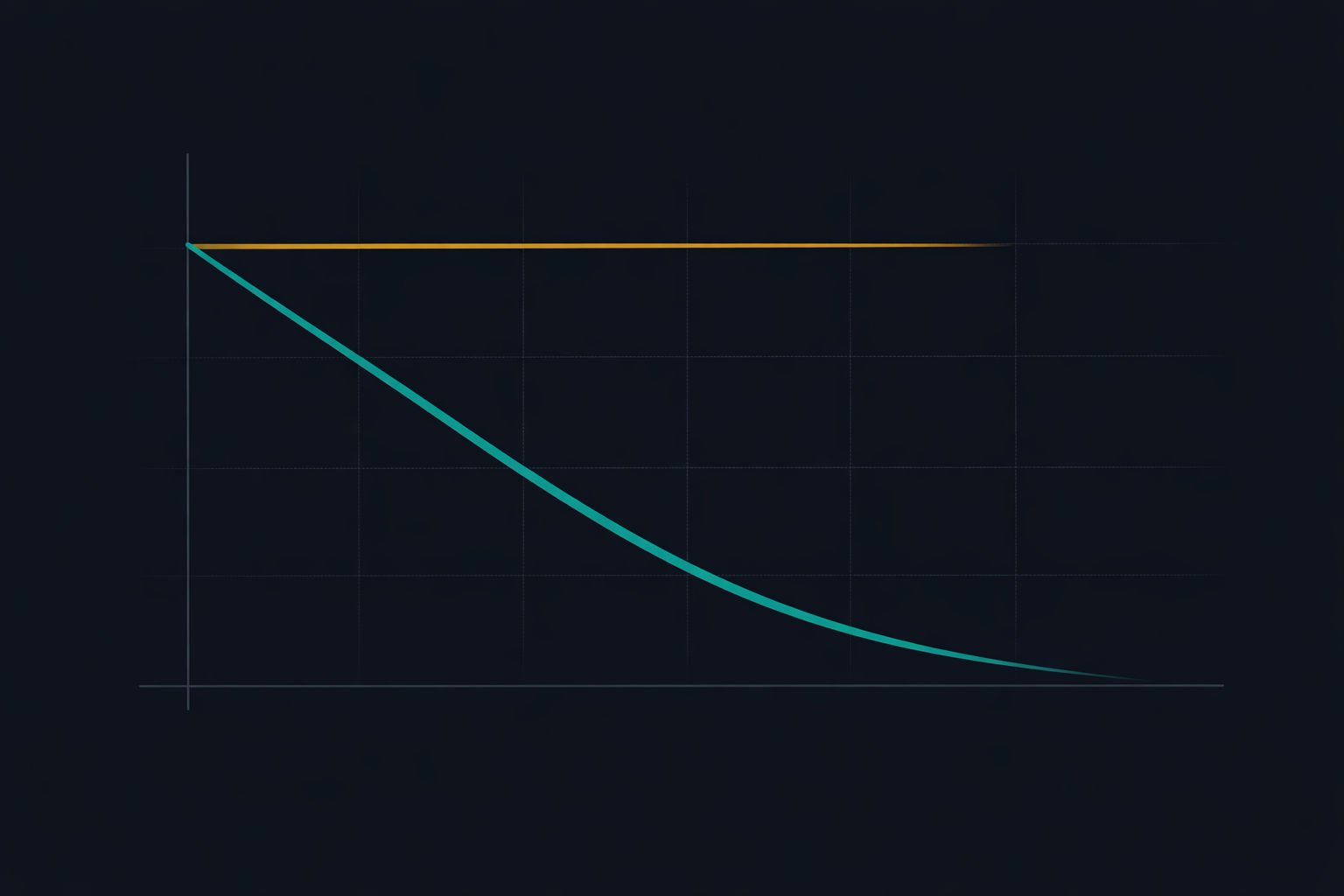
The perception-performance gap: objective cognitive function continues declining while subjective self-assessment plateaus — the hallmark finding of Van Dongen et al. (2003).
The Short Sleeper Myth
Every team has someone who claims they’re fine on five hours. The research says they’re almost certainly wrong.
In 2009, neuroscientist Ying-Hui Fu at UCSF identified the DEC2 gene mutation (P385R) — the first genetic variant linked to natural short sleep. Carriers averaged 6.25 hours per night with no cognitive impairment, compared to 8.06 hours for non-carriers in the same family.
The prevalence of this mutation? Less than 1% of the population.
Contrast that with the data: a 2016 University of Utah study published in Brain and Behavior found that 30% of people claim they don’t need much sleep. And a 2025 SSRS nationally representative survey found 45% of U.S. adults report sleeping six hours or less on an average night.
The math doesn’t work. Roughly 29 out of 30 people who believe they’re short sleepers are simply sleep-deprived people who’ve lost the ability to perceive their own deficit.
As neurologist W. Christopher Winter puts it: “The vast majority of people who say they’re short sleepers, what they’re really saying is, ‘I can do 6.5 hours or less of sleep better than the average person.’ Most people who would fall into that category would actually function a little bit better with more sleep.”
These are not people who've trained themselves to wake up early. They're born this way.
The Performance-Perception Gap: Why Self-Assessment Fails
This is the most operationally dangerous finding in the sleep productivity research: sleep-deprived people cannot accurately assess how impaired they are.
Van Dongen’s 2003 study made this explicit. Subjects restricted to 6 hours per night showed subjective sleepiness that increased for the first few days and then leveled off — while their objective cognitive performance continued to decline linearly for the full 14 days. The gap between how impaired they were and how impaired they felt grew wider every day.
This has a direct parallel in knowledge work. You’re the one evaluating the quality of your own output. If sleep deprivation impairs your prefrontal cortex — the same region responsible for self-monitoring, error detection, and judgment — then your ability to assess whether your work is good is compromised by the same mechanism degrading the work itself.
You can’t trust the instrument that’s broken to tell you it’s broken.
What the Research Says Actually Works
The evidence doesn’t point to complicated sleep hacks. It points to two things: consistency and light management.
Sleep Regularity Matters More Than Total Hours
A UK Biobank study of approximately 60,000 adults, published in Sleep (2024), found that sleep regularity — measured by the Sleep Regularity Index — was a stronger predictor of mortality than total sleep duration. Irregular sleepers who got 8 hours had worse outcomes than consistent sleepers who got fewer hours. Regular sleep patterns reduced all-cause mortality risk by 20–48%.
Matthew Walker’s work reinforces this: maintaining a consistent wake time anchors your circadian rhythm and improves sleep quality even if total duration fluctuates slightly. The practical implication is counterintuitive — a fixed wake time matters more than trying to “catch up” on weekends.
Light Exposure: The Circadian Reset
Harvard’s Charles Czeisler has spent decades demonstrating that light is the primary synchronizer of the human circadian clock. His research shows that light exposure timing determines when your body releases melatonin and cortisol — the hormones that gate sleep onset and morning alertness.
Key findings from his lab:
Evening light exposure (especially blue-rich light from screens) delays your circadian clock, pushing sleep onset later
Even moderate light (~600 lux) is as effective as bright light therapy (~2,500 lux) for circadian resetting
The practical protocol is straightforward: get bright light within the first hour of waking. Reduce screen brightness and overhead lighting in the 60–90 minutes before bed. This isn’t about sleep hygiene platitudes — it’s about manipulating a measurable biological input.
Audit Your Sleep Like You Audit Your Calendar
Step 1
Fix your wake time — and don't move it
Choose a consistent wake time 7 days a week. This is your circadian anchor. A fixed wake time has stronger effects on sleep quality and cognitive performance than total hours, per the UK Biobank research. Vary it by no more than 30 minutes on weekends.
Step 2
Count backward to set a non-negotiable bedtime
From your wake time, count back 7.5–8 hours. That's your target sleep window. Treat this boundary the same way you'd treat a morning meeting with a client — it's not optional.
Step 3
Create a shutdown ritual that protects your sleep block
Use the last 15–20 minutes of your workday to close open loops. Review tomorrow's plan, capture unfinished tasks, and write down what's on your mind. This is your cognitive boundary between work and wind-down — what Cal Newport calls a 'shutdown complete' ritual. In Daybook, an end-of-day planning block serves this function: you're not just planning tomorrow, you're giving your brain permission to stop processing work.
Step 4
Manage light exposure on both ends
Bright light (natural or artificial) within 60 minutes of waking. Dim light and reduced screen brightness 60–90 minutes before bed. Per Czeisler's research, this is the single most effective intervention for circadian alignment.
Step 5
Track the result, not the feeling
Don't rely on how you 'feel' — the Van Dongen study proved that subjective assessment is unreliable under sleep restriction. Instead, track objective markers: time to first productive output, error rates, number of context switches, or how long your deep work blocks actually hold. Correlate those with your sleep data over 2–3 weeks.
The Uncomfortable Bottom Line
If you’ve invested time in learning about deep work, focus blocks, and ultradian rhythms, but you’re consistently sleeping less than seven hours, you’re optimizing the engine while running it on fumes.
The neuroscience of sleep and cognitive performance is not a frontier debate. The prefrontal cortex findings are replicated. The memory consolidation mechanisms are causal. The performance-perception gap is documented across multiple labs and protocols. And the economic data — $411 billion in annual U.S. GDP lost to insufficient sleep, per RAND — reflects the aggregate cost of millions of knowledge workers making slightly worse decisions, slightly more slowly, every day.
Sleep is not the variable you trade for more hours. It’s the variable that determines what those hours are worth.
The research isn’t asking you to sleep more because it’s good for you. It’s telling you that the work you’re doing on six hours is measurably worse than the work you’d do on seven and a half — and you can’t feel the difference. That’s not an opinion. That’s a finding.
Protect Your Deep Work — Starting With How You End Your Day
Daybook's end-of-day planning block gives you a structured shutdown ritual: capture tomorrow's priorities, close open loops, and create a clean boundary between work and rest. Keyboard-first, plain text, built for the way you actually think.